|
Arnhemweavers Workshop
Information
These workshops are offered to women
interested in
Yolŋu culture where the focus is textiles.
The knowledge and skills
the participants will be shown by the
workshop leaders has been passed
down for thousands of years, “it is, as it
always has been”.
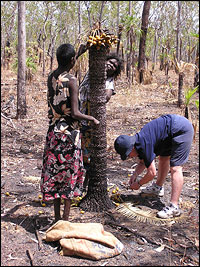
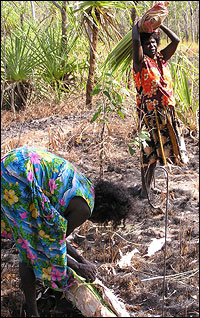
Participants will learn how to collect
barks, pandanus and other
plants. They will then be shown how to
collect and prepare the fibres
for dyeing
before weaving or spinning.
It is assumed that workshop participants
are
motivated to engage with, and learn about
Yolŋu society and therefore
will be keen to learn the traditional
skills offered by these women.
English is not the first language for
these women, but as skilled
linguists, speak as many as twenty Yolŋu
languages.
In addition there will be opportunities
for those
interested participants to take part in
hunting expeditions, including
collecting mud crabs, a variety of
shellfish, fish and other game and
vegetable staples that Mäpuru residents
regularly hunt and collect.
Workshop leaders: A group of
elderly
women who have lived on their ancestral
homelands for most of their
lives daily spin and weave articles
that they need for
themselves, their relatives, for
ceremonies and for sale. These women and their
daughters
have remarkable skill, this is shown by
the extent to which they have
traveled throughout Australia teaching
their skills through workshops
at galleries and museums.
These women are expert at utilising a
variety of
seasonally available materials for their
weaving. They use pandanus
leaves, roots, and bark for spinning and
weaving, as well as a wide
selection of roots, leaves and fruits to
dye the fibres before spinning
and weaving.
These women see this extremely successful
project
as creating meaningful employment as
well as financial
independence for
themselves and their families, they are
striving to create a
welfare-free future for their children,
grandchildren and
great-grandchildren. They can only do this
on their ancestral estates
or homeland.
Location: The workshops
are held
at Mäpuru. Mäpuru is a homeland situated
on the mainland 10 minutes
flight south of Elcho Island, North East
Arnhem Land. The residents are
all Yolŋu and connected ancestrally to the
area. Mäpuru has a
permanent population of about 100.
Accommodation: The
Mäpuru
residents will provide a traditional
shelter for shade. It is
recommended participants bring their own
mosquito domes or small tents.
Phones: There is one
public phone at Mapuru that has a
ring up number, ie people can
ring directly through to the pay phone
number. Mapuru does not have coverage to make
mobile telephone calls.
Ablutions: There is
access to a
clean ‘long-drop’ toilets and cold water show
at the school.
Climate: Mäpuru is in
the
tropics, where the day time temperature is
around 30˚C, and a night
time temperature of about 24˚C. Rain
doesn’t usually fall between May
and November but night time temperatures
can fall to 18˚ in June.
What to take: food (be
prepared
to cook over a fire), eating utensils,
mosquito net or dome (although
there are very few mosquitos, camera, note
book, .., .., ..,
Food: Food is not
provided. There is no regualr and reliable
food outlet at Mapuru.
It is suggested that participants bring
non-perishable food such as muesli,
noodles, canned fish, vegetables and fruit
such as carrots, sweet
potato, oranges, etc.
Travel: Drive to Mapuru: It is
recommended that
participants travel by 4WD to Mäpuru
because it is the cheapest
transport method and enables participants
to take part in excursions
from Mäpuru for hunting and gathering, as
well as traveling through
some beautiful country on the way.
Travel to Mäpuru is usually undertaken by
4WD vehicle. Mäpuru is about 900km from Darwin,
taking a minimum of 12 hours
driving time from Darwin.
Travel: Fly to Mäpuru: It is
possible to
fly to Mäpuru, by charter plane from
Darwin the cost is approximately
$3,000 one-way for four to five people. By
Regular passenger Transport
to Elcho Island then charter to Mäpuru the
cost is approximately $1,200
per person one way. Travel to Mäpuru by
plane is not recommended, as
participants will have no transport while
at Mäpuru however it may be
an option for individuals who have limited
time.
Insurance: The women at
Mäpuru
are eager that their workshops continue to
grow, providing meaningful
engagement with Balanda (non-Indigenous
people) and income for their
families. In an effort to reduce
complications and keep the project
under their control, the women have no
insurance. They do not see that
is necessary as they are undertake to
only;
• provide workshop tuition
• act as guides when procuring materials,
including leaves, bark,
roots, etc.
Participation in all activities is
encouraged, but
if participants decide to involve
themselves in weaving activities such
as pulling down pandanus leaves, digging
dyes, they do so at their own
risk.
Permits: Before any
travel is
undertaken through Arnhemland, ( ie, to
Mäpuru), all participants must
have a permit. These will be organised for
participants through the
Northern Land Council.
Intellectual Property:
Participants are authorised to make
records of workshop activities
solely for their own personal use. No
publication is authorised unless
written permission is granted by Linda
Marathuwarr. Participants may be
asked to sign an agreement to this affect.
While workshop participants
are requested not to take cameras, a
digital camera will be available
at each workshop for all participants to
use, images taken shared with
all participants.
Workshop Costs: The cost
is $200
per day, per person to attend workshops.
Workshop numbers: A
minimum
number of 8 participants are necessary for
the workshops to be offered.
Securing a place in a workshop:
In order to join a workshop it is
recommended prospective participants
contact the two organisations supporting
the Arnhem Weavers:
CERES
Global
and/or Nature
Philosophy.
Post Script: If
participants are
interested in learning about the languages and cultures
of east Arnhem Land it is suggested you contact:
yolngustudies
Last updated Dec 2023
|